

Ode to an Eyesore
Farewell to the big, green, plastic thing
I have been working on various drafts of a post about roses for a week now, but said drafts have been overtaken by events next door.
I told you a while ago that my neighbour in London died. Never knowing whether or not it is appropriate to share someone’s name online without their permission or that of their executors, let’s call him ‘Bob’. That wasn’t his name but that’s what we’ll call him.
I’m pretty sure Bob hated me. I don’t blame him.
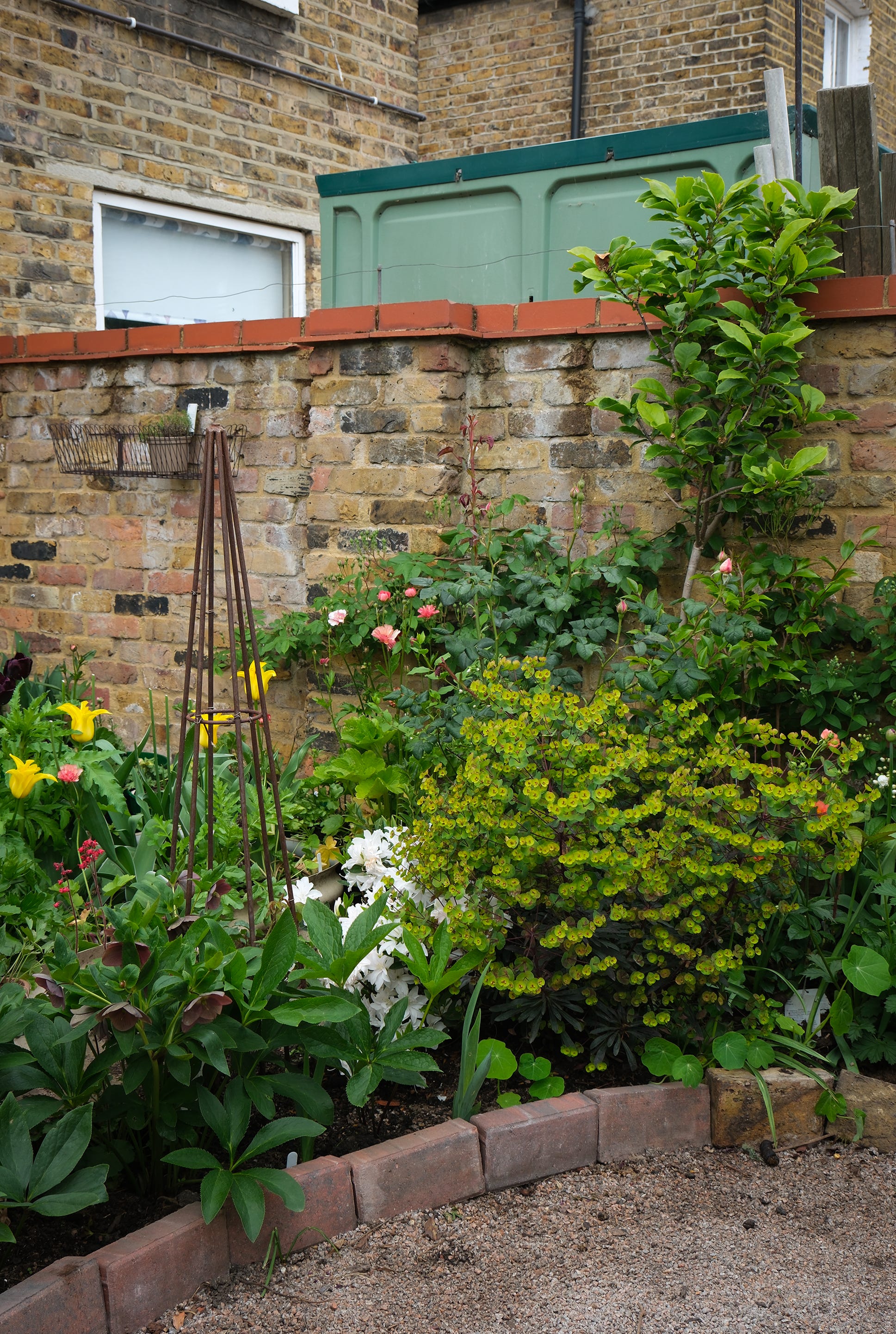
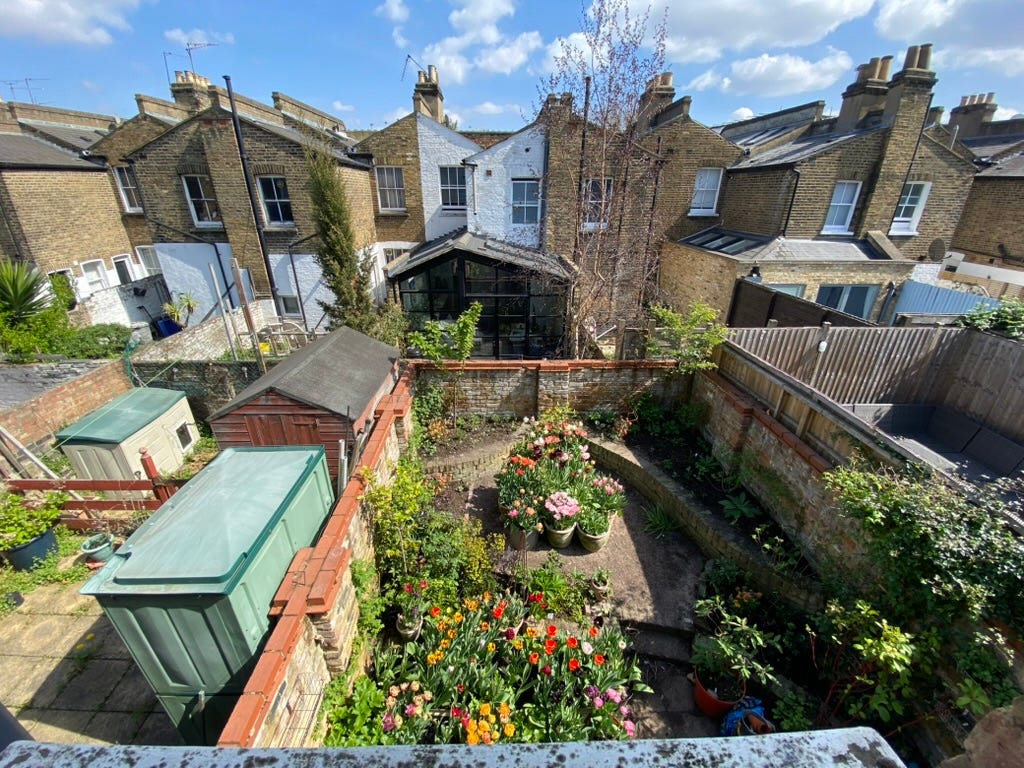
We lived side-by-side on an estate built in the 1870s. These tiny cottages were built for labourers but for much of our time as neighbours neither Bob nor I was labouring much.
For the first couple of years after I bought my house for a little less than a million pounds, I was working flat out. I must have landed like a hurricane - Leo in tow, Bella soon to follow, boyfriend(s) coming and going. Not a lot of loud music and parties, but some.
Poor Bob was left to take in my parcels day after miserable day, and I came to believe that he resented this very much. I was working, earning, and online shopping relentlessly. Day after miserable day, he’d knock on my door almost as soon as I returned home from court and would hold out the offending parcel(s) with neither enthusiasm nor malice, and usually without a word. My thanks were always profuse and I always addressed him as ‘Mr [Surname]’ in order to communicate my gratitude, deference, and respect.
It only really occurred to me after I stopped working - sliding instead into a life of post-burn-out fallowness and relative scarcity like a sore body into a warm bath - how much Bob must have hated me and my parcels.
Based on what I was told by a neighbour after Bob’s death, Bob had lived in that house for many decades, raising his sons there. When we struck up our forced acquaintance he must have been long-since retired and seemed to leave the house only rarely. I have no idea of his age, but he was not so much ageless and ambiguously unkempt.
I came to learn that Bob was a fervently dedicated member of a local bowls club, and was a frequently visitor at a local social club. In short, he had always seemed lonely but after his death I learned that he had a more bangin’ social life than I did at half his age.
But Bob was surely living on a modest, fixed income, and in one of the world’s most expensive cities. I have no idea what Bob did for work, but I do know that he was a Peabody tenant. His home and mine, side by side and identical, are demonstrative of the insane wealth gap that pervades our street, our city, our world.
Our houses were built for labourers, and for centuries were owned and let out at social rents by the Peabody Trust (now just ‘Peabody’. It’s cleaner.) Over time, Peabody began to sell off these units to private buyers. When I bought my house, I think I remember that the estate and its roughly 1,200 homes were still 60% owned by Peabody and 40% privately owned. I would bet that it is closer to 50/50 now.

As private dwellings these houses sell for about £1m each. So, literally side by side, live the most and the least wealthy Londoners.
Our neighbourly relationship - Bob’s and mine - became a touch more complicated when I learned that he sometimes used the ladder that was propped up against our party wall in the garden to climb up and peer in. He once let my cleaner (who had locked herself out) into my home by leading her through his home and up and over the ladder into my garden. It seemed a touch… well-rehearse. Then I caught him one day half up the ladder with a momentum that seemed inevitably to be heading into my garden. This made us both quite uncomfortable, though we never spoke of it.
A few days ago I got home from walking the dogs and a man was using a drill to break into Bob’s front door. I was about to call the police when I noticed his Peabody van and Peabody uniform.
I took the dogs inside and listened to the man trying to get into the house for two hours, smashing at the locks, lock box, and the door itself with various tools. I offered to help. He said if he couldn’t break in to the front door he may need to enter through my home to climb over our party wall into Bob’s back garden. Fine, I said, not mentioning that Bob, elderly and in poor shape, had managed the climb without issue.
Eventually the Peabody man got in to Bob’s house from the front and changed the locks.
Yesterday, from early in the morning until very late in the afternoon, two men stripped out every item that remained in Bob’s home. Smashed up laminated chipboard, piles of documents, bin bags and detritus littered the pavement before being loaded into those rubbish removal vans with big, metal cages on the back.
Then this morning, after our morning dog walk up to our local cafe and back, I fed the dogs and went out into the garden as I always do when it is not raining. I started to scan around, making a mental list of gardening jobs to do, and then realised that something significant had changed.
In the grand clear-out of Bob’s home, the big, green, plastic thing had gone.
I never knew what the big green plastic thing was, but I think it was some kind of storage. I never saw Bob use it. It sat next to a wooden shed in Bob’s entirely paved and entirely neglected plot, the exact size and shape as mine, up against his north-facing wall which is also my south-facing wall.
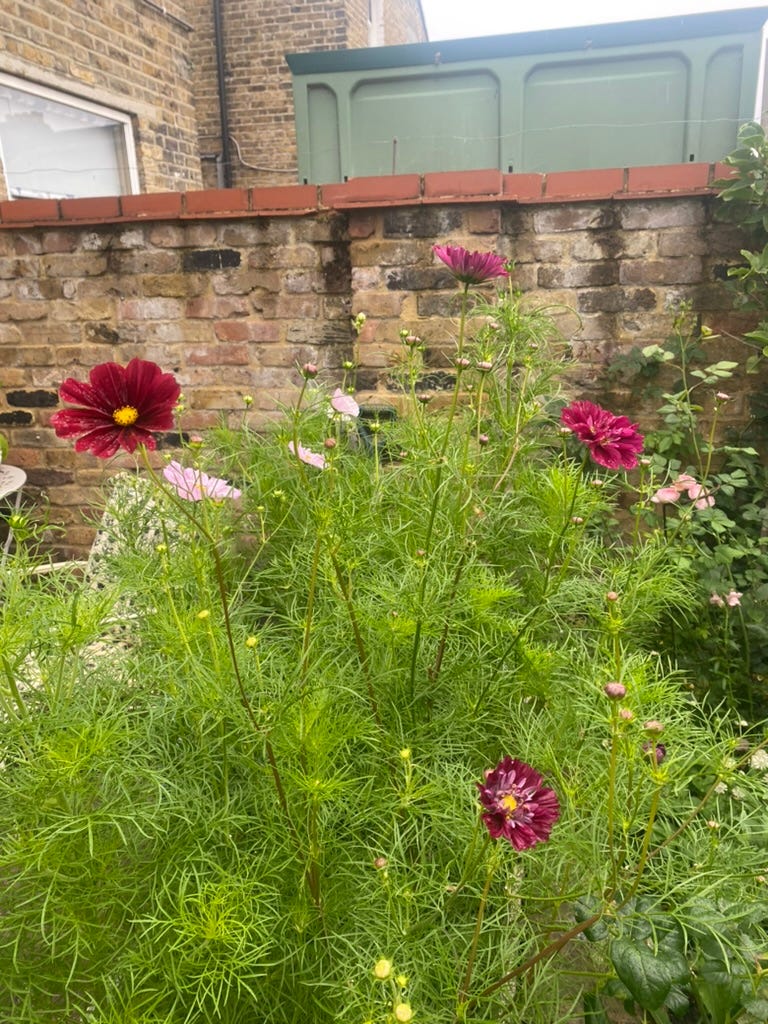
Oh how I hated that big green plastic thing. Oh how it ruined photo after photo of my beautiful, carefully curated garden. There’s about 1/4 of my garden you’ve never seen because it was impossible to crop out the big green plastic thing.
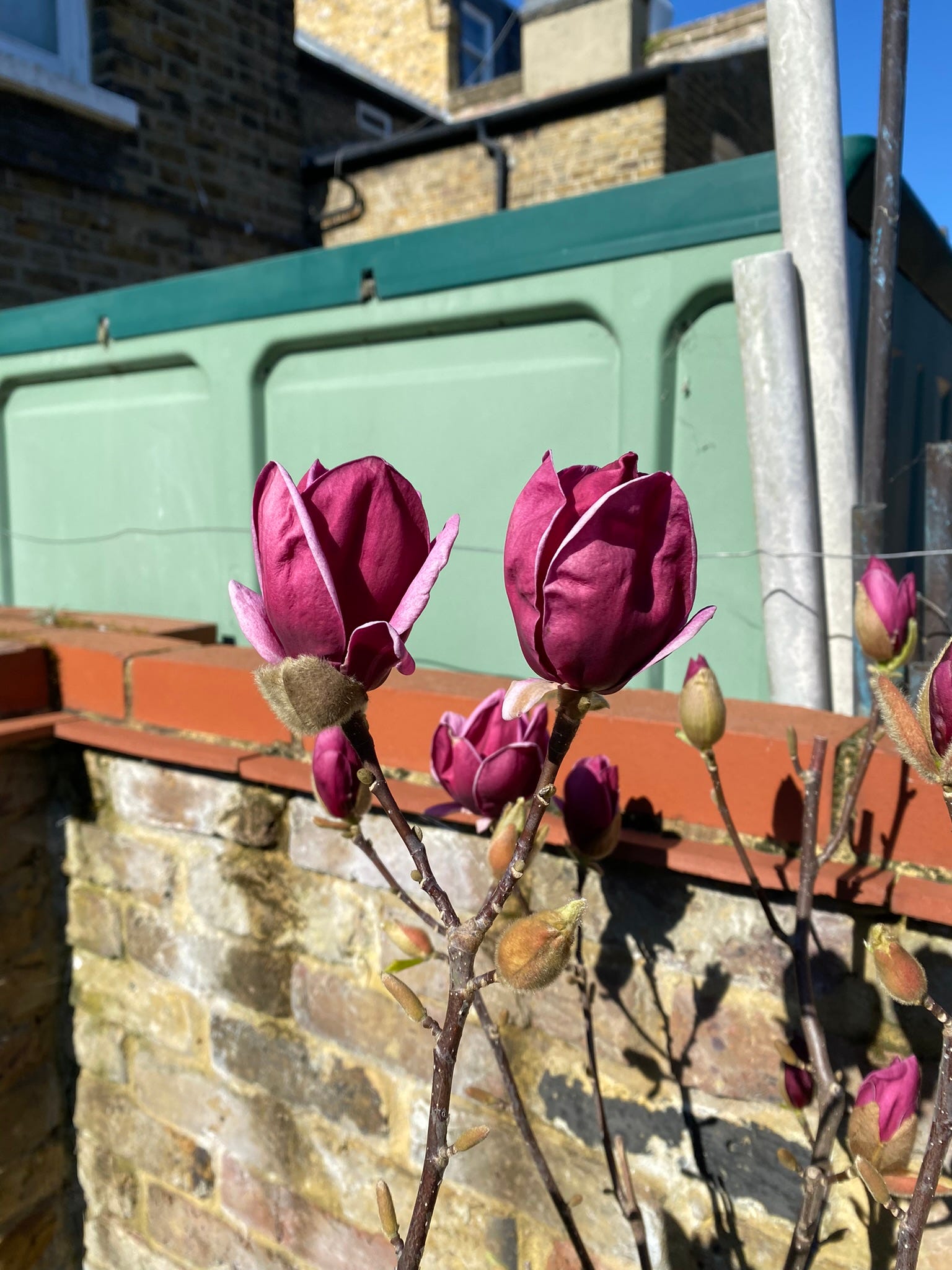
Just as I would frame up a photograph of a magnolia flower, or a shot of the south facing flower bed (inevitably the best bed), there - like the world’s most persistent photo-bomber - was the big green plastic thing.
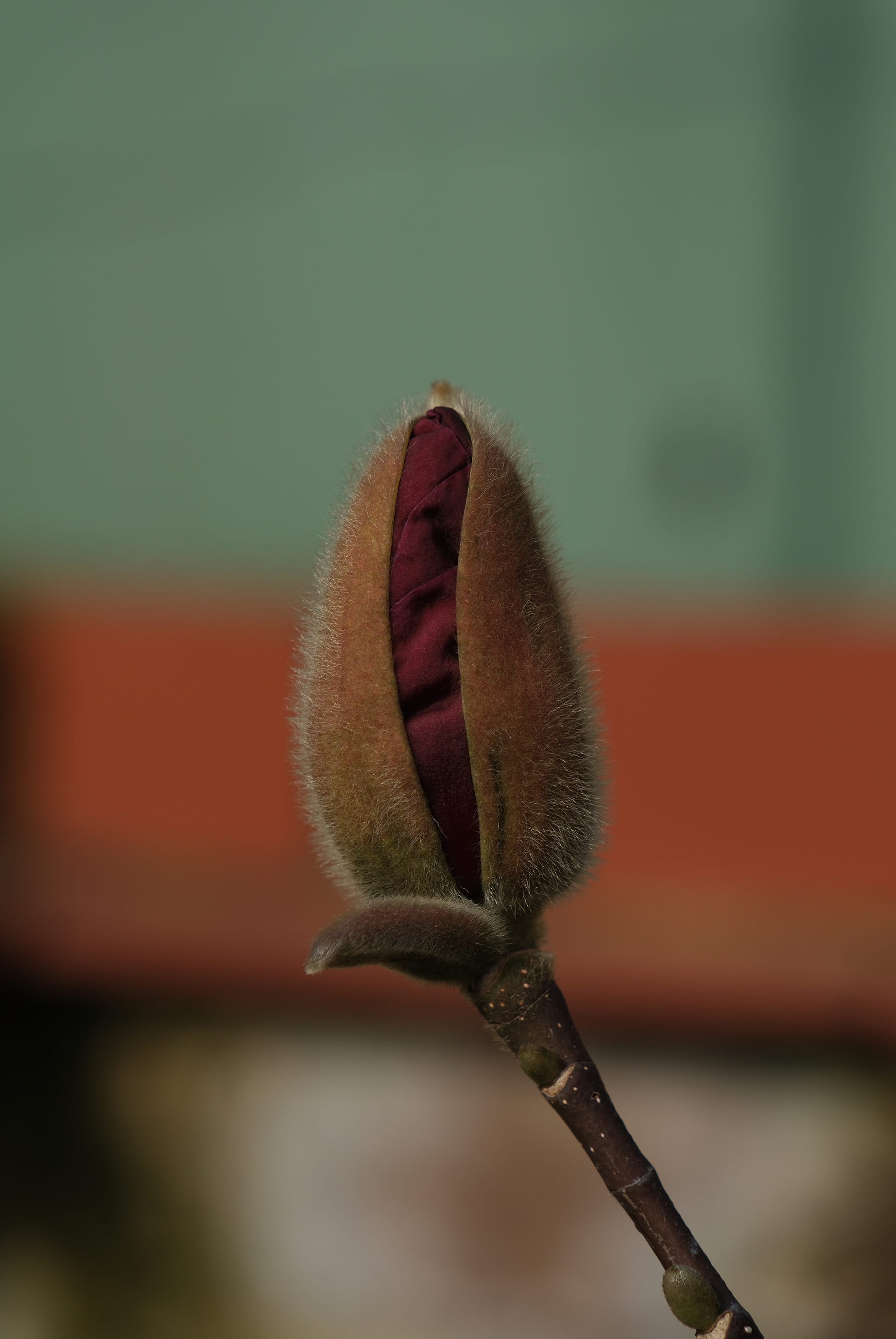
And now it has gone. JUBILATION was my first feeling. But then, like a smiling child missing a front tooth, the garden seemed to be missing something critical, leaving a strange void.
When the breaking-in Peabody man said he might need to enter through my garden, I went through and noticed that Bob’s convenient-for-trespassing ladder had gone. I dragged my bench closer to our party wall so that the breaking-in man would be able to hop over without too much knocking over of plant pots. When I peered over our party wall, I noticed one neat, little plant pot on Bob’s window sill. It was a jarring outlier. An incongruous sign of deliberate gardening in a landscape of grotty paving and weeds.
It was the pot I had given Bob the Christmas before he died, and the hyacinth bulbs had grown their tall, proud leaves again, anticipating flowers.
Today, along with the big green plastic thing, the pot of hyacinths has gone. Bob’s desolate garden is more desolate still.
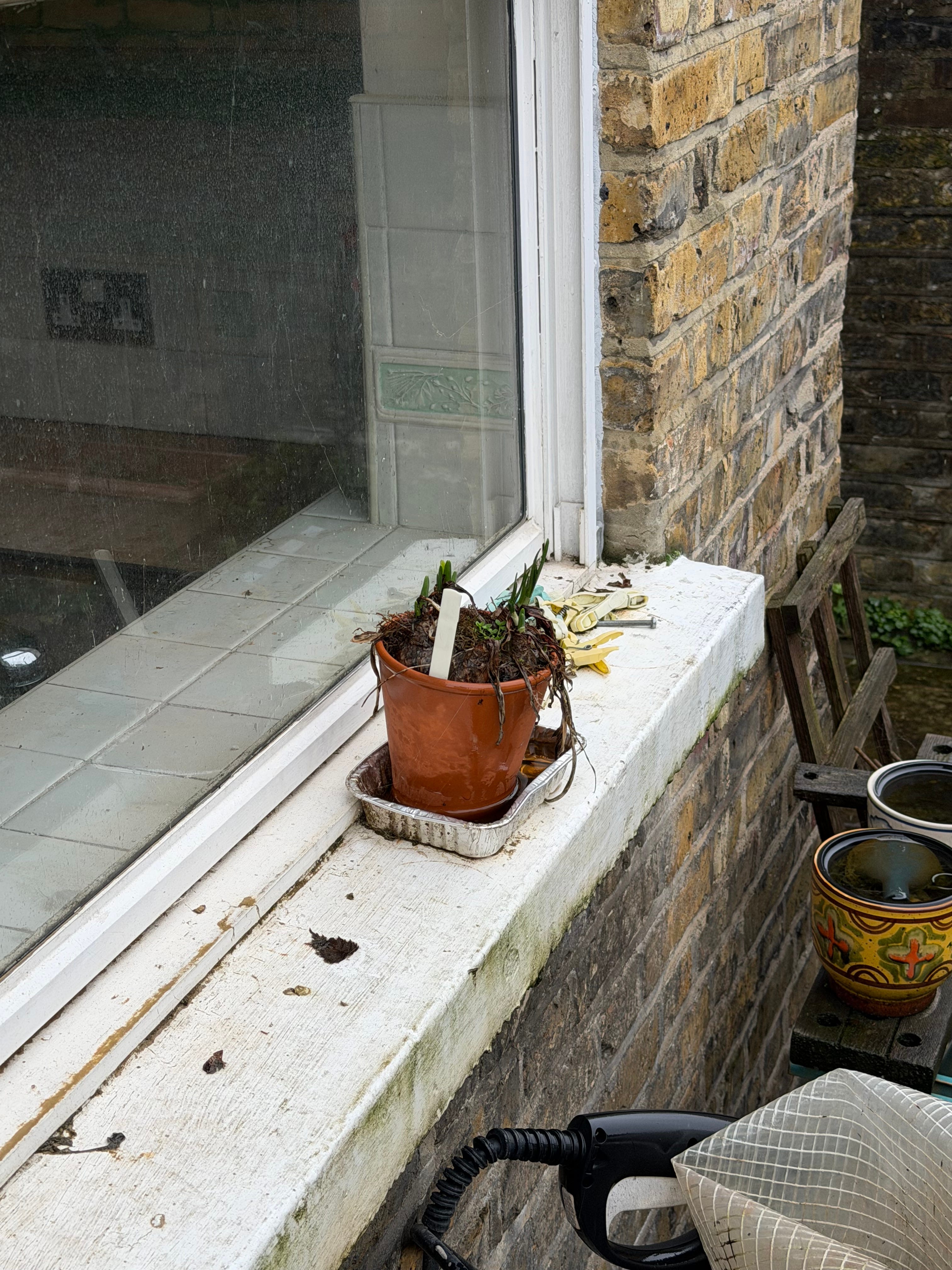
Garden designers often talk about incorporating a ‘borrowed view’ into a garden. My borrowed view was of the ugly back of the big green plastic thing on the left, and on the right, my other neighbours’ too-tall, ugly fencing. The latter I have begun to improve by training Rosa ‘Open Arms’ against it. Plans to block out the big green plastic thing will have to be reconsidered.
As with the child’s gap-toothed smile, one’s eye adjusts over time to the missing thing. Soon I won’t remember that the big green plastic thing was ever there. But then I will look back at photographs of my garden, from its infancy up until today, and I will recall the man next door who smelled strongly of mothballs, took in my parcels, and resented my wealth. He was a man who had a big, green, plastic thing in his garden, and who kept the pot of hyacinth bulbs I gave him two Christmases ago on his kitchen windowsill.
"Smashed up laminated chipboard, piles of documents, bin bags and detritus littered the pavement before being loaded into those rubbish removal vans with big, metal cages on the back."
We're just going through documents and photographs left by my mother in law. Poignant, family history. Just like those piles of documents and detritus you mention.
Our lives, left. Isn't it devastating and awful, what we leave and what it's worth?
Hooray for the eyesore removal but devastating about all his belongings being smashed up and thrown away. It reminded me of Deborah Vass's recent piece about the illustrator Faith Jacques, whose life's work was put out for the binmen when she died and was only saved by chance.